Bedding · Fabric & care
Choosing a Breathable Duvet Cover: Weight, Closures, and Seasonal Layering
A duvet cover does more than protect an insert. Its weave, weight, fastening and care requirements shape how a bed feels from the first cool night of autumn to the first warm morning of spring. Here is how to assess those details—without mistaking a fashionable label for a useful specification.
A duvet cover can look simple folded at the foot of a bed: a sheet of fabric, a row of buttons, perhaps a quiet border. In use, though, it is a small system. It has to move air, accommodate a duvet insert, stay in place as the sleeper shifts, and survive repeated laundering. When those pieces work together, the bed feels comfortable and the cover is easier to live with. When they do not, even attractive fabric can become an everyday irritation.
That is why choosing a breathable duvet cover involves more than identifying a fiber such as linen or cotton. Fiber tells part of the story, but construction helps determine how fabric handles heat and moisture. Weight influences drape and feel. Closures govern how securely the insert remains inside. And the way a cover is cared for can affect whether its texture improves, dulls or wears prematurely.
Organic flax bedding, including options from brands such as Coyuchi, offers a useful point of comparison for anyone researching linen. The brand name, however, should be a starting point rather than a substitute for reading the details. Compare the listed fiber content, fabric weight if provided, dimensions, closure and care instructions. These are the clues that help a cover fit the household rather than merely fit the mood board.
Breathability is a property of the whole fabric
“Breathable” is often used as though it were a single, measurable feature. In practice, the experience depends on several interacting factors: the fiber, yarn, weave or knit, finishing treatment, fabric density, room conditions and bedding layers. A lightweight fabric may allow air to move readily but feel less substantial. A denser fabric may feel smoother and more enveloping, yet retain more warmth under certain conditions.
Linen is made from flax fibers. Its surface often has a distinctive, slightly irregular texture, and linen bedding is commonly valued for air circulation and its ability to handle moisture. That does not mean every linen cover feels identical, or that all linen is automatically cool in every bedroom. A tightly constructed fabric, heavy duvet insert, warm room or additional blanket can change the result. Cotton, silk and blends also vary according to their construction and finish.
It helps to think of breathable bedding as a balance. The cover should feel comfortable against the skin, allow an appropriate amount of warmth to escape and work with the insert beneath it. Someone who sleeps warm in a mild climate may want a different combination from someone who gets cold easily or lives in a home with strong seasonal temperature swings. The best material is not an abstract winner; it is the one that makes sense in context.
What fabric weight can—and cannot—tell you
Fabric weight may be listed in grams per square metre, often abbreviated as gsm. In broad terms, the figure describes the mass of a given area of fabric. It can help when comparing similar fabrics made from similar fibers, but it is not a universal score for comfort or quality. A heavier fabric may feel more substantial and drape differently, while a lighter one may feel airier. Neither result is guaranteed by the number alone.
Weight is affected by more than fiber content. Yarn size, weave density, finishing and fabric treatment all matter. A washed or softened finish, for example, can change how fabric feels in the hand without changing the basic fiber. Two covers with the same stated weight can still feel quite different; two covers with different weights may both suit a warm sleeper, depending on their construction and the duvet insert underneath.
Some product descriptions do not provide a weight figure. That absence need not rule out a cover, but it does make other questions more important. Look for clear information about material, dimensions, weave or finish, country of manufacture where supplied, and laundering. If warmth is a key concern, check whether the maker provides a useful description of the fabric’s feel and construction. Treat broad language such as “all-season” as a prompt to investigate, not as a promise that one cover can control every sleep environment.
It is also worth separating the weight of the cover from the warmth of the bed. A duvet insert, mattress protector, fitted sheet, top sheet and throw can collectively hold more heat than the cover alone. If a bed feels too warm, changing the cover may help, but reducing the insert’s fill or removing a layer may be the more direct adjustment.
Linen texture: relaxed by design, not a flaw
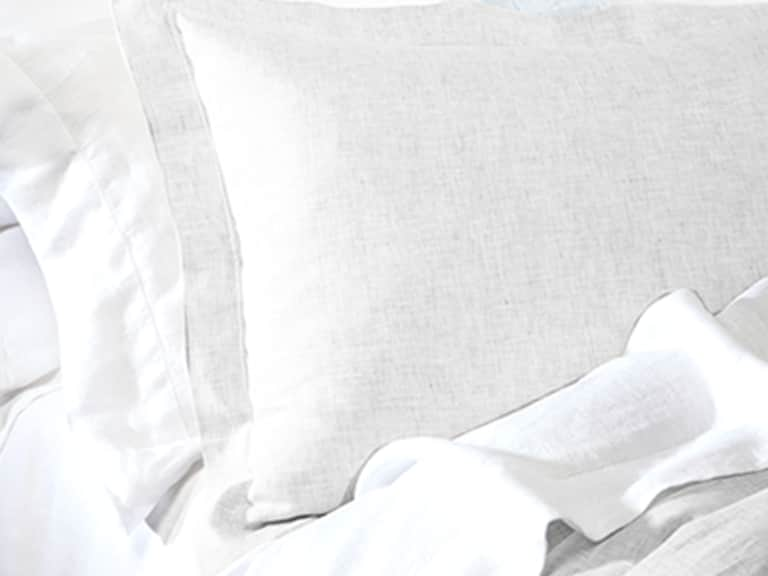
For shoppers considering an organic linen duvet cover, texture is often part of the appeal. Linen tends to have more visible surface character than a finely finished sateen. It can look softly rumpled rather than sharply pressed, a quality that suits bedrooms where ease matters more than a perfectly smooth, formal finish.
That relaxed appearance is not evidence that a cover is poorly made. Nor does it mean every linen cover will have the same hand. Stone washing, garment washing and other finishing processes can soften the fabric before it reaches the bed; the result varies by maker and fabric. With use and laundering, linen may become more supple, but proper care remains important. Abrasion, overloading a washer, harsh products or excessive heat can shorten the life of any textile.
A helpful reference is the DownTown Company Layla Linen Duvet Cover. Its listed construction is 100% flax linen, stone-washed for softness, with hemstitch detail and a tailored flange. The description identifies it as washable and gives Queen and King dimensions. Those specifics illustrate what to look for when comparing a cover: fiber, finish, design details, care practicality and size. They are more useful than a vague assurance that a fabric is luxurious or breathable.
When evaluating Coyuchi or any other brand, apply the same method. Verify the exact item’s composition and care directions rather than assuming that every product within a brand’s range shares the same construction. Collections change, and product names do not tell you whether a particular cover has a button closure, ties, a specified weight or a particular finish. Use the current product information for the specific item under consideration.
Closures are small details with nightly consequences
The opening of a duvet cover may be secured with buttons, a zipper, snaps, ties or another design. Each approach has trade-offs. A button closure is familiar and can be straightforward to repair if a button is lost, though it takes time to fasten. A zipper can make the opening quick to close, but a poorly protected or rough zipper may catch delicate fabric. Ties can help secure an insert at its corners, but they require matching ties inside the cover and insert.
Do not confuse a closure with an insert attachment system. Buttons or a zipper close the opening; interior corner ties or loops help keep the duvet from sliding inside. A cover may have one feature, both, or neither. If your insert tends to bunch or migrate, corner attachments can matter more than the type of opening. Check the product description and, when available, construction details rather than relying on a photograph.
Ease of use also depends on the person changing the bed. A wide opening may make inserting a bulky duvet less awkward. A zipper can be convenient for someone who wants a quick change, while buttons may appeal to someone who prefers a familiar, repairable fastening. For a household with frequent laundry, simplicity and durability may outweigh decorative details.
- Check the insert’s attachment points. Confirm that the cover has ties or loops in positions that can connect to them.
- Inspect the opening length. A generous opening can reduce wrestling with a large insert.
- Consider fabric delicacy. A fastening should not scrape, snag or pull on the cover during washing or everyday use.
- Think about maintenance. Buttons may need replacing; zippers should be handled gently and kept closed when laundering if the care label advises it.
Sizing: the overlooked source of a lumpy bed
A duvet cover should be compatible with the insert’s stated dimensions, not merely with the bed size written on a label. “Queen” and “King” can vary across manufacturers and markets. Measure the insert when possible, then compare those numbers with the cover’s dimensions. A cover that is too small can compress the fill and strain seams. One that is substantially too large may allow the insert to shift and gather in empty space.
Interior ties can make a well-sized cover behave better, but they cannot fully compensate for a major mismatch. If you are mixing an insert and cover from different brands, compare the actual measurements rather than assuming the names align. Account for the insert’s loft, too: a plump duvet may occupy more space than a flatter one of the same length and width.
Before buying, identify the opening location and decide how you prefer to put the cover on. Some people turn it inside out, secure the corners, then roll the cover over the insert; others use a direct method. Either way, a cover with a suitable opening and matching attachment points can make the routine less cumbersome. The most useful design detail is often the one that saves a few minutes every laundry day.
Seasonal layering is a system, not a single purchase
A breathable duvet cover can support seasonal comfort, but it does not create warmth or remove it by itself. The duvet insert is the main insulating layer. Sheets, blankets and the room’s temperature all contribute. That is good news: a household can often adapt the same cover through the year by changing the insert or adjusting the layers beneath and over it.
In warmer months, a light insert—or no duvet insert, depending on preference and climate—can be paired with a breathable cover or used with a top sheet. Linen may be appealing for its textured feel and air movement, while a light cotton cover can suit someone who prefers a smoother surface. The exact experience depends on the fabric and the total bedding setup.
During transitional weather, a midweight insert can offer flexibility. A top sheet lets sleepers adjust their immediate contact layer, while a folded blanket at the foot of the bed can be added only when needed. In colder months, a warmer insert may be more effective than choosing a heavier cover alone. Layering gives each sleeper more control and can prevent the bed from feeling too hot at the start of the night and too cold before morning.
Seasonal change is also a good moment to review the bed rather than simply add another layer. If a room is drafty, a warmer insert may be sensible. If the bedroom is heated overnight, a lighter arrangement might still be comfortable in winter. Climate, insulation, humidity, sleep habits and individual temperature sensitivity all influence the right combination. The calendar is a useful reminder, not a reliable thermostat.
Care instructions belong in the buying decision
A cover can feel breathable and look beautiful, yet prove inconvenient if its care requirements do not suit the household. Read the care label before purchase. Some linen bedding is machine washable; some fabrics require a delicate cycle, gentle detergent or line drying. The fiber name alone cannot tell you what a finished product can tolerate.
Wash the cover according to its specific instructions, and avoid overloading the machine. Space allows fabric to move and rinse more effectively. Separate items by color when appropriate, close fasteners if instructed, and use a mild detergent suited to the textile. High heat can encourage shrinkage or wear, while leaving a damp cover bundled for too long can create musty odors. If line drying is practical, it may reduce mechanical wear, though a low-temperature tumble setting may be allowed by the maker.
Wrinkles deserve perspective. Linen is naturally inclined to crease, and some owners value the lived-in finish. If a crisp surface is essential, be prepared for additional ironing or choose a fabric and finish that better fit that preference. The right care routine is not necessarily the most elaborate one; it is the one you can follow consistently without damaging the textile.
Care also affects how often a duvet cover gets used. A cover that can be washed safely at home may suit a busy household better than one that requires special handling. Consider whether you have a place to dry it, whether the size fits your washer, and whether you want a spare cover available while the first is in the laundry. Practical planning is part of comfort.
Organic claims call for precise questions
“Organic” can refer to a certified agricultural material or to standards applied at other stages of processing, depending on the product and certification named. If a bedding description makes an organic claim, look for the specific certification and what it covers. A certification may concern the fiber, processing, manufacturing chain or another defined set of criteria; it should not be assumed to mean that every environmental or labor question has been answered.
For an organic flax duvet cover, useful details include the stated fiber composition, the named certification where applicable, and the source or manufacturing information supplied by the maker. Consider what is absent as well as what is present. A clear description makes comparison easier, but shoppers may need to consult the brand’s documentation for the scope of a certification. Treat broad words such as “natural,” “pure” or “eco-friendly” as descriptions to examine, not as complete evidence.
This is another reason a brand such as Coyuchi can serve as a research reference without ending the inquiry. Compare its current product specifications with those of other makers, using the same questions for every item. A fair comparison is specific: it weighs fiber, construction, finish, care, fit and documented standards, not just brand reputation or photography.
A practical checklist before you decide
When product pages offer a flood of adjectives and a shortage of useful facts, return to the fundamentals. The following checklist can help narrow the options without pretending there is one ideal duvet cover for every sleeper.
- Material: Is the fiber content clearly stated, including any blends?
- Construction: Is there information about weave, weight or finish that helps explain the feel?
- Fit: Do the cover’s dimensions match the insert, and does it have suitable attachment points?
- Closure: Is the opening convenient, secure and appropriate for the fabric?
- Care: Can you follow the washing and drying directions with your available equipment?
- Season: Will the cover work with the insert and layers you plan to use?
- Verification: Are claims about organic content or certification specific enough to check?
There is no need to chase the highest weight, the most elaborate fastening or a single fashionable fiber. A sound choice is a cover that fits the insert, feels right against the skin, works with the room’s temperature and can be cared for without turning laundry into a separate project. For a warm sleeper, that may mean a lighter-feeling fabric and a less insulating insert. For someone who wants a relaxed texture and practical washability, a linen option may be worth a closer look.
In the end, the duvet cover’s quiet achievement is not that it promises perfect sleep. It is that it makes the bed easier to adapt: a breathable surface when the room is warm, a protective shell for the insert, a layer that can be washed and replaced, and a design that suits the way the household actually lives. Weight, closures and seasonal layers may seem like small decisions. Taken together, they are the difference between bedding that merely looks settled and bedding that works.